



If you’re comparing AAC vs brick, material price is only part of the story. Installation time, labour availability, thermal performance, acoustic performance and the total cost of the finished wall can all affect which option is better for your build.
Instead of laying individual bricks, AAC wall systems use large-format AAC panels, which can make installation significantly faster.
Other AAC options available from Dahlsens include Helix AAC and James Hardie Gravis.
So, is AAC better than brick? Here’s how they compare.
Comparison
AAC vs brick at a glance
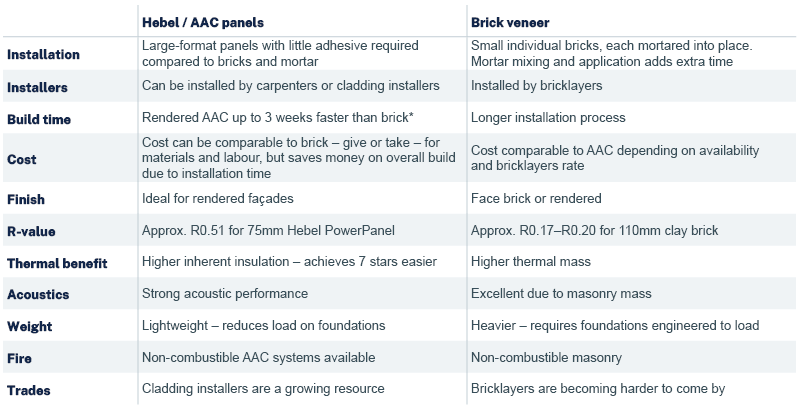
*Actual time savings vary depending on the project, site conditions, weather and trade availability.
Cost
AAC vs brick cost: which is cheaper?
A common question is: is AAC cheaper than brick?
There’s no single answer because AAC vs brick cost depends on the project. Instead of comparing the price of an AAC panel with the price of bricks, compare the total installed cost of the finished wall. There is also the boost to cash flow that comes with faster builds, and reaching lock-up payments sooner, plus the ability to complete more homes in a year.
A rendered brick veneer wall includes bricks, mortar, brick ties, bricklaying labour and rendering.
An AAC wall or other AAC system includes AAC panels, fixings, adhesives, installation labour and the specified coating or render system.
For a home that’s going to be rendered anyway, AAC can be particularly competitive because of its faster installation.
The better question is: What will the finished wall cost – and how quickly can I get it built?
Installation Time
AAC can save up to three weeks in build time
Speed is one of the biggest advantages when comparing AAC vs bricks.
Brickwork is constructed one brick at a time. AAC panels and other AAC concrete panels are much larger (the equivalent of 90 bricks), allowing installers to cover substantial wall areas quickly. Bricklayers also need to mix large volumes of mortar which demands further time.
For a rendered home, AAC can save up to three weeks in build time compared with rendered brick.*
Getting the external walls completed sooner can help builders:
- reach lock-up payments earlier
- get following trades on site sooner
- reduce delays between construction stages
- reduce reliance on bricklayer availability
- keep the overall build moving
With skilled bricklayers in short supply, this can be an important advantage for builders managing tight construction programs.
Thermal Performance
AAC vs brick: thermal performance
AAC also offers an advantage in inherent thermal resistance.
A 75mm Hebel PowerPanel has a material R-value of approximately R0.51, compared with approximately R0.17–R0.20 for a typical 110mm clay brick. This can reduce the reliance on extensive insulation and can keep homes cooler in summer and warmer in winter.

This means the AAC panel itself can provide around 2.5 to 3 times the thermal resistance of a typical clay brick layer.
Brick does, however, provide greater thermal mass.
The final thermal performance of either option depends on the complete wall system, including insulation, cavities, framing and internal linings.
Acoustics
AAC vs brick: acoustic performance
Both Hebel walls and brick walls can provide good acoustic performance.
A 75mm Hebel PowerPanel has published acoustic performance of approximately Rw 36, while complete Hebel external wall systems can achieve approximately Rw 38–42, depending on their construction.
Brick also performs very well acoustically because its high mass helps reduce sound transmission.
For both options, the final acoustic result depends on the complete wall system – including insulation, cavities, plasterboard, windows, doors and installation quality.
Rendered Finish
Can AAC look like rendered brick?
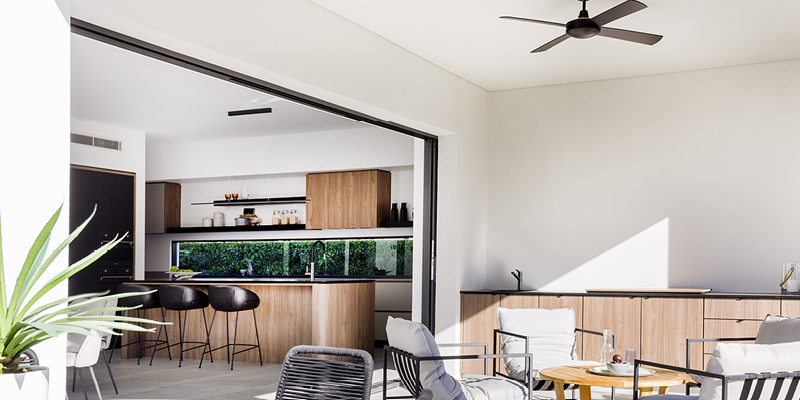
Yes. Once finished, AAC and rendered brick can achieve a very similar appearance.
The main difference is what’s behind the render.
With rendered brick, the brick veneer is constructed first and then rendered. AAC cladding and other AAC panel walls provide a substrate that can be finished with a compatible coating or render system.
If the home is already designed to have a smooth rendered façade, AAC is therefore well worth considering.
Foundations
What about foundations?
Another difference between AAC vs brick is weight.
AAC is significantly lighter than traditional masonry. An AAC or AAC panel wall places less dead load on the building structure and foundations than a comparable brick wall.
This can be an advantage when designing a new home, particularly on sites with challenging soil conditions or where reducing structural loads is beneficial. Depending on the project, the lower weight of AAC may also provide greater flexibility in the footing and structural design.
However, using AAC doesn’t automatically mean smaller or cheaper foundations. Footings and slabs still need to be designed by the appropriate engineer for the site conditions, building loads and selected wall system.
AAC vs brick: how long will they last?
Both brick and AAC are designed to provide long-lasting external wall solutions when correctly specified, installed and maintained.
Brick has a well-established reputation for durability and has been used in Australian homes for generations. Face brick also requires relatively little ongoing maintenance.
AAC is a durable, inorganic material that won’t rot and is resistant to termites. Invented in Europe in 1920, it’s been used as a building material since the 1940’s when it was first reinforced with steel.
AAC panels and other AAC concrete panels can provide a long service life when installed as part of an approved wall system and protected with the specified coating or render system.
The main difference is maintenance. Face brick can generally remain exposed, while rendered AAC relies on its external coating system, which should be inspected and maintained over the life of the building. Rendered brick also requires ongoing maintenance of its rendered finish.
So when comparing longevity:
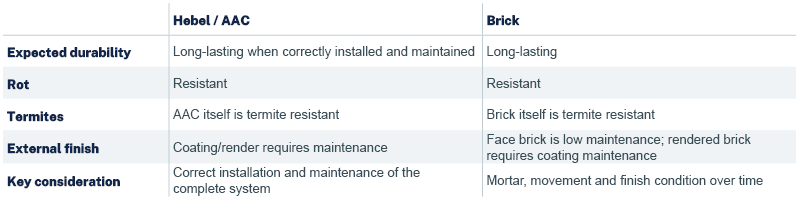
For a rendered home, the maintenance comparison between AAC and brick becomes closer because both options rely on a rendered or coated external finish.
Is AAC better than brick?
It depends on the project.
Brick may be better when:
- you want an exposed face brick finish
- traditional masonry is preferred
- high thermal mass is a priority
AAC or AAC may be better when:
- you want a rendered finish
- faster installation is important
- bricklayer availability is an issue
- higher inherent thermal resistance is important
- you want a lighter external wall system
For a rendered home, the potential to save up to three weeks in build time can make AAC particularly attractive.

AAC brands to choose from
Builders now have several AAC panel systems to choose from.
Dahlsens supplies AAC solutions including CSR Hebel, Helix AAC and James Hardie Gravis, depending on location and project requirements.
Whether you’re considering Hebel PowerPanel, Helix AAC or James Hardie Gravis Panel, it’s worth comparing the complete system – including panel price, installation, components, render, thermal performance and construction time.
Frequently asked questions
Is AAC cheaper than brick?
It can be. The answer depends on labour, materials, location, wall design and finish. AAC can be particularly competitive against rendered brick veneer because of its faster installation.
Is AAC faster than brick?
Yes. Large-format AAC panels can be installed much faster than individual bricks. Rendered AAC can save up to three weeks in build time compared with rendered brick, depending on the project.
What is the R-value of AAC vs brick?
A 75mm AAC PowerPanel has an R-value of approximately R0.51, compared with around R0.17–R0.20 for a typical 110mm clay brick. The total R-value of the finished wall will be higher once the other wall components and insulation are included.
Can AAC replace brick veneer?
AAC panel systems can provide an alternative to brick veneer on many framed residential projects. Always use a system designed and installed for the specific application.
Compare AAC panels with Dahlsens
Dahlsens supplies AAC panels and systems for builders, including AAC, Helix AAC and James Hardie Gravis.
Whether you’re comparing AAC vs brick, looking for AAC panels, or considering alternative AAC concrete panels, our team can help with product selection, project take-offs, competitive trade pricing and delivery.
Get an AAC quote
Send us your plans and we’ll help you find the right AAC wall system for your project.